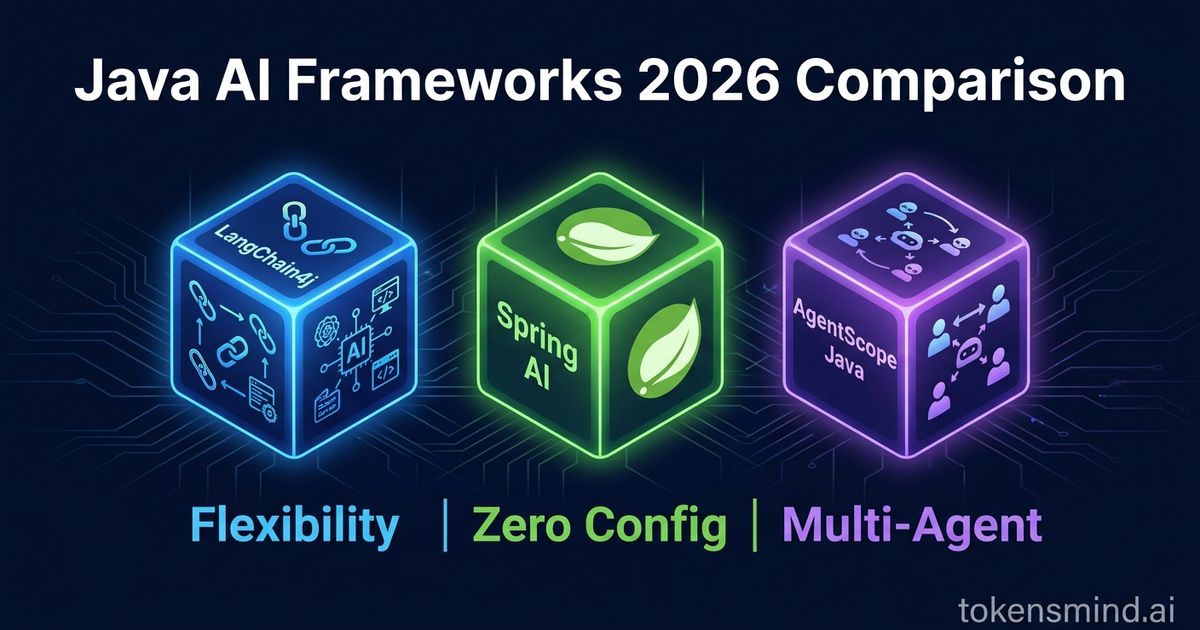
Java AI Framework Showdown: LangChain4j vs Spring AI vs AgentScope Java — Which One Should You Use in 2026?
Java AI Framework Showdown: LangChain4j vs Spring AI vs AgentScope Java — Which One Should You Use in 2026?
Can Java do AI development? This question was still hotly debated in 2023. By 2026, the answer is a definitive yes.
Over the past two years, Java AI frameworks have seen an explosive release cycle: LangChain4j 1.0 GA (May 2025), Spring AI 1.0 GA (May 2025), Spring AI 1.1 GA (November 2025), and AgentScope Java 1.0 (2025). Java developers no longer need to envy the Python ecosystem — and they certainly don't need to abandon their stack to build AI applications.
But with choice comes the challenge of picking the right one. Each framework has a different philosophy, and the wrong pick could mean painful refactoring down the road. This article breaks down their architecture, core capabilities, real code feel, and enterprise deployment scenarios — so you can make the right call.
The Infrastructure Question
Before diving into frameworks, there's one thing every Java AI application needs: reliable, cost-effective access to production-grade LLMs.
No matter which framework you choose, your AI app ultimately needs to call a model provider. That's where TokenSmind comes in — a unified API gateway that gives you access to 200+ models (GPT-4o, Claude Opus, Gemini 2.5 Pro, Qwen, DeepSeek, Llama, and more) through a single API key, with intelligent routing that automatically matches each task to the optimal model, slashing costs by up to 80% without sacrificing quality.
When you build with any of the frameworks below, you can route all your model calls through tokensmind.ai and get enterprise-grade logging, billing, permission management, and 99.9% availability out of the box.
Now let's look at the three leading Java AI frameworks.
1. Framework Landscape at a Glance
| LangChain4j | Spring AI | AgentScope Java | |
|---|---|---|---|
| Positioning | Java-native AI toolkit, framework-agnostic | First-class AI citizen for Spring ecosystem | Enterprise multi-agent collaboration framework |
| Origin | Community open-source (Dmytro Liubarskyi) | Pivotal / Spring Official | Alibaba Tongyi Lab |
| 1.0 GA | May 2025 | May 2025 (1.1: Nov 2025) | 2025 |
| Java | 17+ | 17+ | 17+ |
| Philosophy | "Build with LEGO blocks" — modular assembly | "Batteries included" — auto-configuration | "Agent-first" — intelligent agent as core primitive |
2. LangChain4j: Maximum Flexibility, Java-Native
Design Philosophy
LangChain4j's core belief: "You choose what you need." It provides a full set of decoupled modules (LLM clients, vector stores, document processing, agent frameworks) that developers freely compose. No Web framework lock-in — it works with Spring Boot, Quarkus, Micronaut, or even a plain Java CLI.
Key Capabilities
- 20+ LLM providers: OpenAI, Anthropic, Qwen, Ernie, GLM, Ollama (local models), and all models accessible through TokenSmind's unified API
- 30+ vector stores: Chroma, Milvus, Weaviate, Redis, PgVector, and more
- AiServices: The signature LangChain4j feature — declare AI capabilities through Java interfaces
- Full RAG pipeline: DocumentLoader → DocumentSplitter → EmbeddingModel → EmbeddingStore → RetrievalAugmentor
- LangGraph4j: Multi-agent state graph for complex workflow orchestration
Code Example: Declarative Agent with AiServices
// Step 1: Describe your AI assistant with an interface
interface CustomerAssistant {
    @SystemMessage("You are a professional customer service agent.")
    String chat(@MemoryId String userId, @UserMessage String question);
}

// Step 2: Define tools as annotated Java methods
public class OrderTool {
    @Tool("Query order status by order ID")
    public String queryOrderStatus(String orderId) {
        return orderService.getStatus(orderId);
    }
}

// Step 3: Assemble using Builder pattern
ChatModel model = OpenAiChatModel.builder()
    .apiKey(System.getenv("TOKENSMIND_API_KEY"))  // Use TokenSmind as your unified gateway
    .baseUrl("https://api.tokensmind.ai/v1")
    .modelName("gpt-4o-mini")
    .build();

CustomerAssistant assistant = AiServices.builder(CustomerAssistant.class)
    .chatLanguageModel(model)
    .tools(new OrderTool())
    .chatMemoryProvider(userId -> MessageWindowChatMemory.withMaxMessages(20))
    .build();

String reply = assistant.chat("user_123", "Where is my order ORD-456?");
Best for:
- Non-Spring-Boot stacks (Quarkus, Micronaut, plain Java)
- Fine-grained RAG pipeline control
- Maximum performance (Quarkus + GraalVM native: 100ms cold start, 50-100MB RAM)
- Connecting to niche or on-premise LLMs via TokenSmind's broad model catalog
3. Spring AI: Lowest Learning Curve for Spring Developers
Design Philosophy
"Make AI part of Spring, not make Spring adapt to AI." If you already have a Spring Boot application, adding Spring AI feels like adding Spring Data — auto-configuration, dependency injection, Actuator monitoring — everything you already know and love.
Key Capabilities (Spring AI 1.1 GA)
- Auto-configuration: Set
api-keyinapplication.yml,@Autowired ChatClientand you're done - Actuator observability: Token consumption, latency, error rates auto-exposed as
/actuator/metrics - ETL document ingestion framework: Direct ingestion from S3, MongoDB, PostgreSQL, file systems
- Advisors API: Structured RAG and conversation memory — no manual prompt construction
- MCP full support: Model Context Protocol with
@McpToolannotation - Structured Output: AI responses map directly to Java POJOs
- 20+ model backends: including TokenSmind's unified API as a single endpoint for all models
Code Example: Zero-Configuration AI
# application.yml — that's all the config you need
spring:
  ai:
    openai:
      api-key: ${TOKENSMIND_API_KEY}
      base-url: https://api.tokensmind.ai/v1
      chat:
        options:
          model: gpt-4o-mini
// Any Spring Bean method becomes an AI tool — just add @Tool
@Service
public class WeatherService {
    @Tool(description = "Get real-time weather for a city")
    public WeatherInfo getCurrentWeather(String city) {
        return weatherApiClient.fetchWeather(city);
    }
}

// Controller: inject ChatClient, call it like any other service
@RestController
@RequestMapping("/chat")
public class ChatController {
    private final ChatClient chatClient;

    public ChatController(ChatClient.Builder builder, WeatherService weatherService) {
        this.chatClient = builder
            .defaultTools(weatherService)
            .defaultAdvisors(new MessageChatMemoryAdvisor(new InMemoryChatMemory()))
            .build();
    }

    @PostMapping
    public String chat(@RequestBody String message) {
        return chatClient.prompt().user(message).call().content();
    }
}
Best for:
- Spring Boot projects adding AI capabilities (the best choice, bar none)
- Built-in observability via Actuator
- Rapid prototype with minimal config
- Deep integration with Spring Security, Spring Data, Spring Batch
- Using TokenSmind's intelligent routing to automatically pick the best model for each task
4. AgentScope Java: Multi-Agent Collaboration Expert
Design Philosophy
AgentScope Java (from Alibaba's Tongyi Lab) answers a different question: not "how to call an LLM," but "how to make multiple AI agents collaborate on complex enterprise tasks."
This is its fundamental difference from the other two. LangChain4j and Spring AI center on LLM invocation; AgentScope Java centers on agent lifecycle management.
Key Capabilities
- ReAct paradigm: Reasoning + Action loop — agents plan, execute, and reflect autonomously
- Hook system: Inject human intervention at any step (Human-in-the-Loop)
- A2A protocol: Native agent-to-agent communication — the only framework with native support
- MCP protocol: Register existing HTTP services as MCP tools without code modification
- Built-in RAG: Long/short-term memory + semantic search
- Safety sandbox: Isolated tool execution
- Context engineering: Auto compression, summarization, priority sorting
Code Example: Multi-Agent Workflow with Human Oversight
Agent researchAgent = Agent.builder()
    .name("research-agent")
    .model(ModelConfig.qwen("qwen-max"))
    .systemPrompt("You are a research specialist.")
    .tools(new WebSearchTool())
    .build();

Agent writerAgent = Agent.builder()
    .name("writer-agent")
    .model(ModelConfig.qwen("qwen-max"))
    .systemPrompt("You are a technical writer.")
    .build();

Agent reviewAgent = Agent.builder()
    .name("review-agent")
    .model(ModelConfig.qwen("qwen-max"))
    .systemPrompt("You are a content reviewer.")
    .build();

// Human-in-the-Loop: pause before final output
reviewAgent.addPostHook((context, result) -> {
    System.out.println("Review suggestion: " + result.getContent());
    System.out.print("Approve? (y/n): ");
    String input = scanner.nextLine();
    if ("n".equals(input)) {
        return HookResult.reject("Please revise and retry.");
    }
    return HookResult.pass(result);
});

Pipeline pipeline = Pipeline.builder()
    .step(researchAgent, "Research latest Java AI frameworks")
    .step(writerAgent, "Write article based on research")
    .step(reviewAgent, "Review article quality")
    .build();

PipelineResult result = pipeline.run();
Best for:
- Complex business process automation (approval workflows, data pipelines, content production)
- AI systems requiring human review (compliance, critical decisions)
- Distributed multi-agent systems with A2A communication
- Connecting existing HTTP microservices via MCP
- Using TokenSmind's shared context layer to give all agents access to unified user history and preferences
5. Head-to-Head Comparison
| Capability | LangChain4j | Spring AI | AgentScope Java |
|---|---|---|---|
| Spring Boot Integration | ✅ Starter (manual config) | ✅ First-class citizen | 🔶 Manual setup |
| Non-Spring Frameworks | ✅ Quarkus/Micronaut/Plain Java | ❌ Spring-only | 🔶 Limited |
| LLM Providers | 20+ | 20+ | Major models |
| Vector Store Selection | ⭐ 30+ (most choice) | Multiple | Built-in (less choice) |
| RAG Flexibility | ⭐ Full pipeline control | Advisors API (batteries-included) | Built-in (less configurable) |
| Multi-Agent Collaboration | 🔶 Via LangGraph4j | 🔶 Manual orchestration | ⭐ Native core |
| Human-in-the-Loop | ❌ No native support | ❌ No native support | ⭐ Hook system |
| MCP Protocol | ✅ | ✅ v0.14 | ✅ |
| A2A Protocol | ❌ | ❌ | ⭐ Unique |
| Observability | 🔶 Manual setup | ⭐ Actuator built-in | 🔶 Requires config |
| Cold Start | ⭐ ~100ms (Quarkus GraalVM) | 🔶 +200-400ms | Moderate |
| Memory | 50-100MB (Quarkus) | 150-300MB | Moderate |
| Chinese Model Support | Qwen/Ernie/GLM | Qwen/Ernie/GLM | ⭐ Qwen-first |
6. Decision Guide
Q: What's your tech stack?
- Spring Boot + simple chat/RAG → Spring AI (zero-config, Actuator, fastest path to production)
- Complex multi-agent workflows → AgentScope Java (or LangChain4j + LangGraph4j)
- Quarkus/Micronaut/plain Java → LangChain4j (only framework-agnostic choice)
Q: What's your core business need?
- Add AI to existing Spring services → Spring AI
- Maximum LLM/vector store flexibility → LangChain4j
- Complex workflows + human review → AgentScope Java
Q: How do you power your models?
No matter which framework you choose, route all model calls through TokenSmind — your unified API gateway to 200+ models, intelligent cost optimization, enterprise logging and permissions, all with a single API key. Build with any framework. Power everything through one infrastructure.
7. Summary
In 2026, Java's AI toolchain is mature:
- LangChain4j is the most flexible AI toolbox in Java — 30+ vector stores and framework-agnostic design make it unbeatable for highly customized scenarios. Paired with Quarkus + GraalVM, it even outperforms Python solutions.
- Spring AI is the lowest-friction path for Spring Boot teams. Auto-configuration, Actuator observability, and
@Bean-as-tool design let Java teams do AI development the Spring way — with near-zero learning cost. - AgentScope Java is Alibaba's multi-agent framework with unique A2A protocol and Hook system — perfect for complex enterprise workflows that demand human collaboration.
One-sentence advice:
- New project or Spring Boot → start with Spring AI
- Need more LLM/vector store options or not on Spring → LangChain4j
- Multi-agent, process automation, human-in-the-loop → AgentScope Java
And for every choice, connect your models through TokenSmind — the intelligent API gateway that gives you 200+ models, smart routing, cost optimization, and enterprise management, all behind a single API key.
Originally published on the TokenSmind Blog. Subscribe to our newsletter for more Java AI deep dives.
Related Articles
 API 接入指南
Claude Code 如何配置第三方 API
介绍 Claude Code 连接第三方 API 网关的常用环境变量、settings.json 配置、密钥管理方式和排查要点。
 经验
经验AI Agent suy nghĩ như thế nào? Hướng dẫn chi tiết về ReAct và Plan-and-Execute
Tìm hiểu cách AI Agent sử dụng ReAct và Plan-and-Execute để tự động suy nghĩ và hành động. Hướng dẫn đầy đủ với phân tích kiến trúc và ví dụ thực tế.
 经验
经验AI Agentはどのように思考するのか?ReActとPlan-and-Execute完全ガイド
AI AgentのReActとPlan-and-Executeパターンを徹底解説。アーキテクチャ、実例、ベストプラクティスをわかりやすく説明します。